In the pursuit of elucidating the distinction between the notions of praise and worship, as they pertain to the spiritual praxis of the devout, it behooves us to undertake a disquisition reminiscent of the method employed by the venerable St. Thomas Aquinas. The Angelic Doctor, in his monumental Summa Theologica, availed himself of a dialectical method, presenting arguments, counterarguments, and his resolutions thereto. Following this hallowed template, let us consider the essence of both praise and worship, their respective places within the life of the faithful, and how their differentiation illuminates the path of devotion.
Article 1. Whether Praise and Worship Constitute the Same Act of Devotion
Objection 1. It seems that praise and worship are identical, for both are directed towards the glorification of the Almighty. As expressions of veneration, they appear to merge into a singular act of piety, leaving no room for distinction.
Objection 2. Further, the Scriptures often use the terms interchangeably, suggesting a conflation of their meanings. Therefore, one might argue that any attempt to distinguish between them is a futile exercise in semantics.
On the contrary, St. Augustine asserts, “Praise involves proclaiming the deeds of God, whereas worship is the submission of oneself to His divine will.” This implies a fundamental difference in orientation and object.
I answer that, praise and worship, while closely related in their aim to honor the divine, differ substantially in both nature and object. Praise is an act of acknowledgment and celebration of the attributes and deeds of God. It is fundamentally an outward expression, often communal and vocal, of admiration and reverence for His infinite goodness, power, and mercy. In praise, the faithful recount the greatness of God, His wondrous works, and His manifold blessings. It is, in essence, an act of the intellect and the voice, engaging the believer in a testament to God’s glory.
Worship, on the other hand, is characterized by a profound act of the will, whereby the soul submits itself entirely to God. It transcends mere verbal acknowledgment, encompassing a total surrender and adoration of the divine will. Worship involves not only recognition of God’s supreme nature but also an internal, personal offering of oneself to Him. It is the highest form of reverence a believer can accord to God, often manifest in prayer, the sacraments, and the living out of His commandments.
Reply to Objection 1. Although praise and worship are directed towards the same ultimate end—the honor and glory of God—they engage the believer in fundamentally different ways. Praise is the articulation of God’s excellence, while worship is the soul’s total submission to His divine sovereignty.
Reply to Objection 2. The scriptural intertwining of praise and worship serves not to conflate their essence but to underscore their complementary nature in the life of piety. Each serves its unique purpose in guiding the faithful towards a fuller expression of devotion.
Article 2. On the Necessity of Distinguishing Between Praise and Worship in the Devout Life
It is thus manifest that the spiritual life is enriched by a proper understanding and practice of both praise and worship. By engaging in praise, the faithful are continually reminded of the nature and works of God, fostering a spirit of gratitude and joy. Through worship, believers are drawn into a deeper relationship with the divine, marked by obedience, love, and surrender. Together, praise and worship constitute the twin pillars upon which a robust spiritual life is built, each indispensable and irreplaceable in the journey towards union with God.
In further elucidation of the distinction between praise and worship within the devout life, it is imperative to underscore an element intrinsic to worship, which profoundly demarcates its essence from that of praise: the element of sacrifice. This consideration not only deepens our understanding of worship but also illuminates a pivotal theological divergence between Catholicism and Protestantism—the nature and significance of the Mass as a sacrificial act.
Article 3. Whether Sacrifice is Essential to Worship
Objection 1. It seems that sacrifice is not essential to worship, for worship, as previously discussed, entails the submission of the will to God, which can be accomplished through prayer and obedience without necessitating an act of sacrifice.
Objection 2. Moreover, in the era of the New Covenant, Christ’s singular sacrifice on the cross is deemed sufficient for the redemption of humanity. Thus, it could be argued that further sacrifices are redundant and do not constitute a necessary component of worship.
On the contrary, the Council of Trent defines the Mass as “the true and proper sacrifice” of the New Covenant, wherein the Church, participating in the Eucharist, makes present the one sacrifice of Christ. This sacrificial character is not merely commemorative but an actual participation in the redemptive act of Christ, effectuated through the ordained ministry.
I answer that, worship, in its highest form, necessarily involves sacrifice, for it is through sacrifice that the believer’s submission to God is most profoundly expressed. Sacrifice, in the context of worship, signifies the offering up of something valuable as an act of homage and submission to the divine will. It is a tangible manifestation of the internal surrender of the worshipper to God.
In the Catholic tradition, this understanding of sacrifice reaches its zenith in the celebration of the Mass, wherein the Eucharist is understood not merely as a communal meal or memorial but as a re-presentation of the sacrificial death of Christ on the cross. The Mass, thus, is both sacrificial and sacramental, embodying the Church’s participation in the eternal offering of the Son to the Father, mediated by the ordained priesthood. This sacramental sacrifice is central to Catholic worship, for it actualizes the covenantal relationship between God and His people, effected through Christ’s sacrificial love.
Reply to Objection 1. While true worship indeed involves the submission of the will to God, the act of sacrifice embodies this submission in a concrete, visible form. Sacrifice is the outward sign of inward devotion and surrender, amplifying the sincerity of the worshipper’s submission.
Reply to Objection 2. The sufficiency of Christ’s sacrifice does not negate the need for the Church to continually offer sacrifice in worship but rather qualifies the nature of the sacrifice offered. The Eucharistic sacrifice is not a repetition of Christ’s sacrifice but a sacramental participation in it, made possible through the unique authority of the Catholic priesthood, ordained to act in persona Christi, in the person of Christ.
Article 4. On the Authority to Consecrate in the Mass as Distinguishing Catholic Worship
The distinction between Catholicism and Protestantism in matters of worship is fundamentally encapsulated in the understanding and practice of the Eucharistic sacrifice. The Catholic Church upholds that through Holy Orders, ordained ministers are granted the authority to consecrate bread and wine, transubstantiating them into the Body and Blood of Christ. This act of consecration, which lies at the heart of the Mass, underscores the sacrificial character of Catholic worship, affirming the Church’s participation in the mystery of Christ’s sacrifice.
This understanding contrasts with various Protestant conceptions of the Lord’s Supper, which, while deeply reverential and significant, often emphasize memorial and communal aspects over the sacrificial and sacramental. Thus, the sacrificial Mass, celebrated by ordained ministers capable of consecrating the Eucharist, stands as a testament to the depth of Catholic devotion, encapsulating both the essence of worship as sacrifice and the unique authority conferred upon the Church to mediate this sacred mystery.
In the luminous expanse of Christian devotion, where faith seeks understanding and love yearns for expression, the Catholic Church, standing upon the bedrock of apostolic tradition and divine sacramentality, proclaims the Mass—not merely as an act of remembrance, but as a living, breathing re-presentation of Christ’s eternal sacrifice. Herein lies the profound mystery and majesty of Catholic worship: that in the humble offerings of bread and wine, through the consecratory authority of the ordained priesthood, heaven touches earth, time intersects eternity, and the faithful are invited into the very heart of divine love. Thus, in the face of contention or misunderstanding, let it be unequivocally declared: the Mass, in its sacrificial essence and sacramental depth, is not merely a feature of Catholic devotion but the very summit and source of the Church’s life and mission, a celestial banquet where the soul finds its truest home, in the sacrificial heart of worship.
To our Protestant brothers and sisters, a gentle, fraternal query arises: In the gatherings of your Sunday service, amidst the fervent hymns of praise and the earnest sermons of faith, does the essence of your worship transcend the bounds of mere praise to touch the profound realm of sacrificial worship, as envisioned by Christ and enacted through His apostles? Is there, within your tradition, a space wherein the act of worship embodies not just the vocalization of God’s greatness, but a participatory share in the sacrificial love that underpins the Eucharist, inviting a reflection on the fullness of worship God intends and so richly deserves?
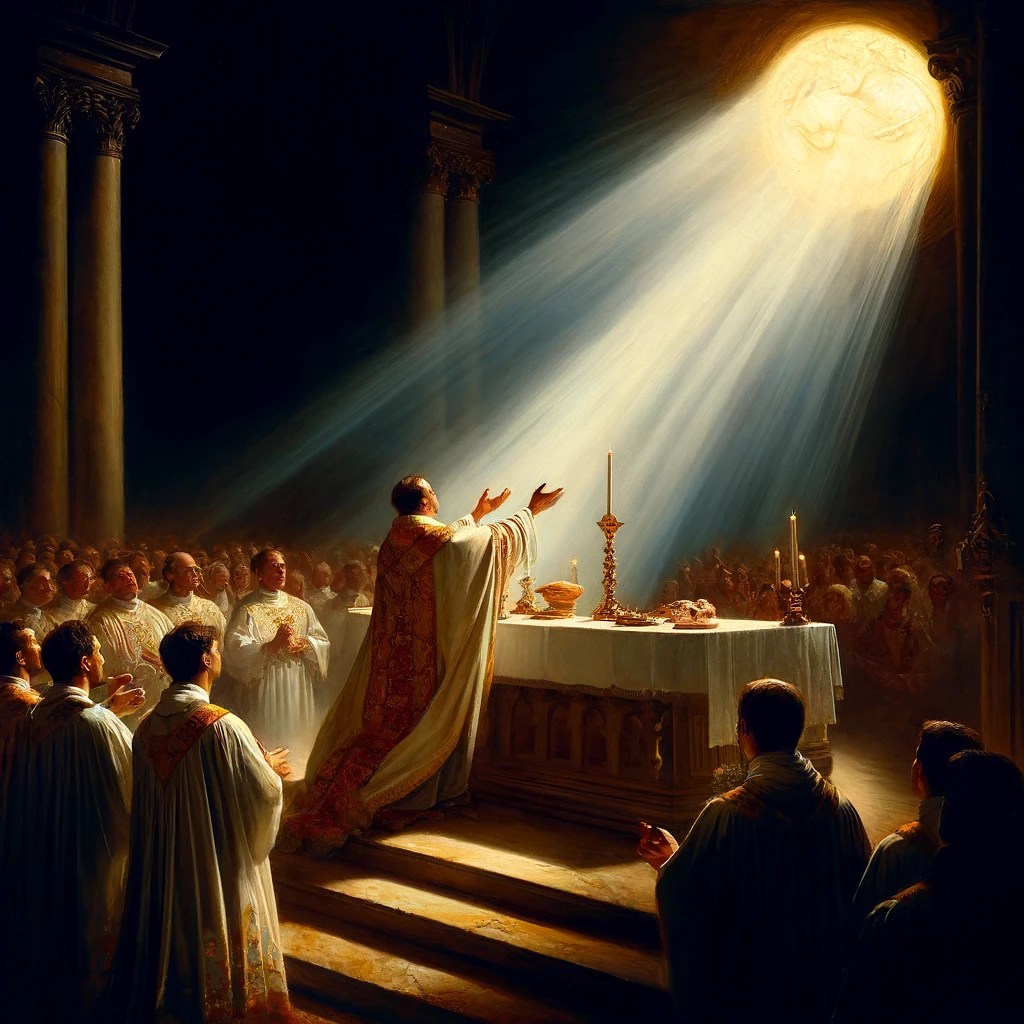
To my Catholic brothers and sisters: As you stand witness to this divine moment of consecration, where heaven and earth commune at the altar, a pressing question beckons to the heart of every lukewarm Catholic: Do you grasp the profound gravity of the Mass? This isn’t merely a weekly ritual or a requirement to fulfill; it is the very act that embodies our faith, the sacramental offering that renews the covenant between God and humanity. In this sacred exchange, where bread and wine become the Body and Blood of Christ, consider how deeply entwined your soul is with this divine mystery. The Mass is not just a pathway to grace—it is the vessel of our salvation. How, then, can we approach it with anything less than our fullest heart and deepest reverence? Let this image be a reminder of the Mass’s transformative power, inviting you to ponder: Do I truly take this celestial banquet, which has the power to save my soul, seriously?
Gentlemen, let’s be real men of faith.

 Disciples At The Ready