
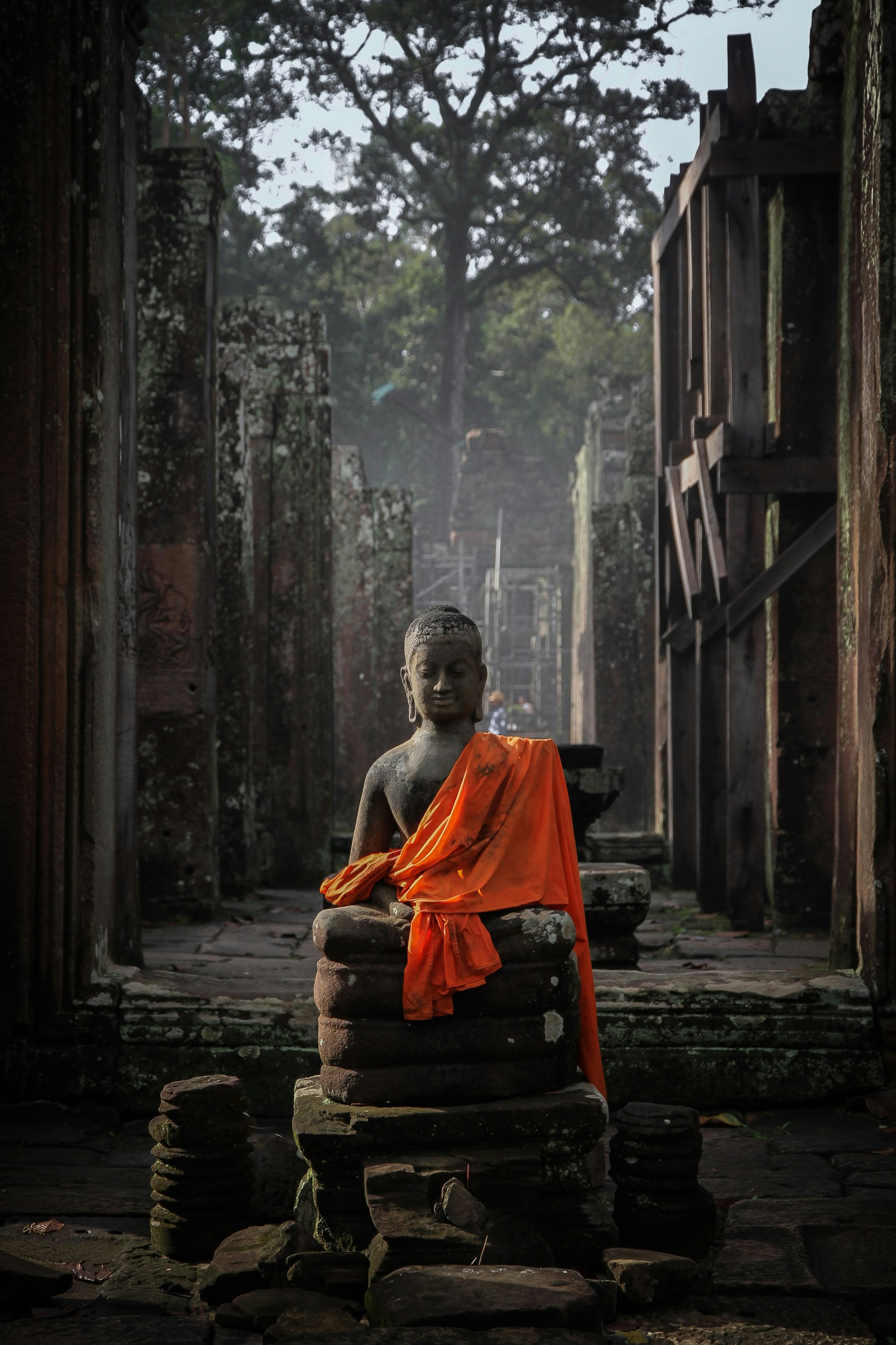
I did not grow up Christian. I was raised in a Buddhist home shaped by immigration, memory, and obligation rather than by formal religious institutions. In America, our practice looked nothing like the tradition my mother had known in Vietnam. There was no temple nearby, no monks, no communal rhythm of worship. What remained was the family altar, quiet and constant, standing in our home as a visible link to a world my parents had left behind. That altar carried more than incense and offerings. It carried identity, loyalty, and expectation. For my mother, faith was not a private exercise of belief but an inherited responsibility. In Vietnam, families supported the temple, honored the monks, and lived within a shared religious framework. Her expectation was straightforward: her children would honor what she honored and carry forward what she had received. To step outside that tradition was not interpreted as curiosity or exploration but as betrayal.
When I began reading about Christianity, I understood immediately that I was approaching a breaking point. This was not because I despised my upbringing or wanted to reject my family’s past. It was because I respected it enough to recognize the cost of asking certain questions. The moment my interest surfaced, the response was swift and severe. There were warnings about shame and dishonor. There were threats of being cut off. Relatives spoke as though I had already turned my back on them. That experience taught me something I would later recognize again and again in the stories of converts: fear rarely announces itself as fear. It disguises itself as loyalty, conviction, and certainty. People convince themselves that they are defending truth, when in reality they are defending stability.
It was in this context that the words of St. John Henry Newman began to make sense to me: “To be deep in history is to cease to be Protestant.” Newman was not questioning sincerity or devotion. He was naming a reality. History has a way of stripping away assumptions. Once you encounter the continuity of the early Church, once you see how belief, worship, and authority developed together rather than in isolation, it becomes impossible to unsee. My struggle, I slowly realized, was not with doctrine itself but with the fear of what truth might demand from me. That same fear is something I now recognize among many Protestant pastors who speak passionately about truth, exhort others to seek it, defend it, and stand firm in it, yet grow uneasy when the history of the Church is placed before them in full.
When the writings of the earliest Christians are read carefully, when the structure they lived under is examined honestly, and when the sacraments they practiced are taken seriously, something shifts. Some become defensive. Some grow uneasy. Some refuse to engage at all. This reaction is rarely driven by malice. It is driven by fear. C.S. Lewis captured this dynamic with uncomfortable clarity when he wrote, “If you look for truth, you may find comfort in the end. If you look for comfort, you will not get either.” Many pastors fear that following truth beyond their current framework will cost them comfort: comfort in their ministry, comfort in their identity, comfort in the structures that support their livelihood, and comfort in what they have always taught.
G.K. Chesterton, who approached Catholicism reluctantly and with resistance, described this tension precisely when he wrote, “The Christian ideal has not been tried and found wanting. It has been found difficult; and left untried.” That difficulty reveals itself in subtle ways. A pastor who loves Scripture may hesitate to examine the Church that defined the canon he preaches from. A preacher may quote the early Church Fathers selectively while avoiding their full context, because their unity with Catholic teaching becomes unmistakable. A sincere believer may resist the idea that the faith of the apostles survived not through private interpretation, but through a visible and authoritative body. This hesitation is understandable. I felt something similar when I faced the fear of breaking with the tradition that shaped my family’s identity.
St. Augustine understood this interior resistance when he wrote, “People travel to wonder at the height of the mountains… and they pass by themselves without wondering.” We often avoid looking inward because we sense what the search might uncover. The same avoidance appears when believers refuse to examine the Church’s history honestly. When I finally studied the early Christians without filters, without apologetic shortcuts or inherited assumptions, the conclusion became unavoidable. The Church they lived in did not resemble the fragmented denominational landscape of modern Christianity. Their unity was visible, their worship was sacramental, and their understanding of authority pointed to a single, continuous body. Scott Hahn, another convert who wrestled deeply with these questions, expressed the realization succinctly when he said, “Once you see the Church as the early Christians saw it, you cannot return to the idea that Christianity is a loose collection of individuals interpreting Scripture on their own.”
Truth does not negotiate with fear. It imposes demands. It requires honesty and courage. If I, raised in a home where leaving my inherited practice carried the real risk of losing my place within my own family, could follow truth at that cost, then pastors who preach courage can afford to approach the early Church with the same resolve. If their beliefs withstand historical scrutiny, they will stand. If they do not, clinging to them out of fear serves no one. The search for truth does not threaten faith; it refines it. As St. Catherine of Siena wrote, “Nothing great is ever achieved without much enduring.” Enduring doubt, enduring risk, and enduring the possibility that what one discovers will reshape an entire worldview are not signs of weak faith. They are marks of discipleship. Truth, once found, brings a clarity that no threat can unsettle.

 Disciples At The Ready