
Quite a few years ago I was at a party when the conversation turned to religion, I forget how, but it was about a certain teaching that dealt with the deuterocanonical books. It always turns religious with me, haha. Someone asked what I believed, and after I answered, a lutheran buddy jumped in with confidence and said, “Y’all added seven books to the Bible.” He said it like he had just settled the matter. I asked him one simple question: “Added them when?” Without hesitation he replied, “The Council of Trent.” That answer is incredibly common. It gets repeated so often that people assume it must be true. In his mind, the story was simple. Martin Luther challenged the Catholic Church on things like indulgences, justification, works, the authority of the pope, and other doctrines, and then Catholics supposedly responded by rewriting the Bible to defend themselves. So I asked him if he knew that the same list of books Catholics have today had already been formally listed more than a thousand years before Trent at the councils of Hippo in 393 and Carthage in 397. Silence. The story he had been told didn’t include that part.
It’s also worth pointing out something many people don’t know about Luther himself. He didn’t originally believe indulgences were wrong in principle. In his Ninety-Five Theses he wrote, “Christians are to be taught that the pope does not intend the buying of indulgences to be compared in any way to works of mercy” (Thesis 42). In another thesis he says, “Let him who speaks against the truth concerning papal indulgences be anathema and accursed” (Thesis 71). Those statements don’t sound like someone rejecting indulgences outright. They sound like someone criticizing abuses surrounding them. That doesn’t resolve every issue surrounding the Reformation, but it shows how the simplified version of events people repeat today often ignores the actual sources.
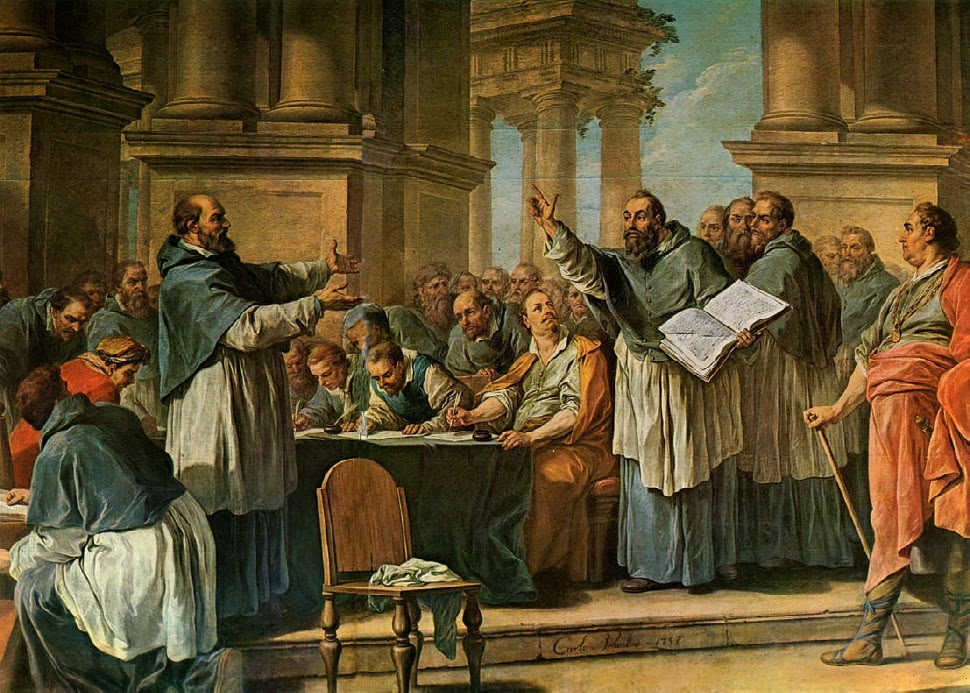
When confusion spreads in the Church, councils are called. This isn’t something that started in the Middle Ages. In fact, the first council of the Church is recorded in Scripture itself. In Acts 15 the apostles and elders gathered in Jerusalem to resolve a dispute about whether Gentile converts had to follow the Mosaic law, particularly circumcision. After discussion, testimony, and discernment, a binding decision was issued to the churches. The letter they sent included these words: “For it has seemed good to the Holy Spirit and to us to lay upon you no greater burden than these requirements” (Acts 15:28). That moment is important because it shows the Church acting together to resolve doctrinal confusion. The apostles did not tell everyone to go read their Bibles privately and decide for themselves. They gathered, discerned together, and then spoke with authority for the whole Church.
That same pattern continues throughout Christian history. The First Council of Nicaea did not invent Christ’s divinity. It defended that truth against Arianism, which taught that the Son was a created being and not fully God. The Council of Chalcedon did not invent the doctrine that Christ is fully God and fully man. It clarified that teaching against errors that blurred Christ’s divine and human natures together. The Council of Carthage did not create the Bible. It formally listed the canonical books after centuries of discussion about which writings could be read publicly as Scripture. And the Council of Trent did not add books to the Bible. It reaffirmed the canon that had already been recognized for more than a thousand years. Councils don’t invent revelation. They clarify what the Church already believes when disagreement or confusion forces the issue.
The early Church Fathers understood this connection between Scripture and the Church. Irenaeus wrote in the second century, “Where the Church is, there is the Spirit of God; and where the Spirit of God is, there is the Church and all grace.” He argued that the apostolic faith was preserved through the Church’s unity and leadership. Augustine of Hippo was even more direct. He wrote, “I would not believe the Gospel unless moved by the authority of the Catholic Church.” Augustine wasn’t downplaying Scripture. He was explaining how he knew which writings were actually the Gospel in the first place. He was pretty dang clear about that. Athanasius of Alexandria, writing in his Festal Letter of 367, listed the twenty-seven books of the New Testament and distinguished them from other Christian writings that were helpful but not Scripture. Even in the fourth century the Church was still clarifying these distinctions.
Many objections to the Church’s role in the canon rely heavily on a verse from John’s Gospel: “My sheep hear my voice, and I know them, and they follow me” (John 10:27). The assumption is that believers recognized Christ’s voice in Scripture and therefore the canon formed naturally without the Church needing to step in. But that explanation doesn’t line up with history. The early Church had real disagreements about certain books. Hebrews was questioned in some regions. James, Jude, 2 Peter, and Revelation were disputed in others. Eusebius of Caesarea described some writings as universally recognized, others as disputed, and still others as rejected. That doesn’t sound like a situation where everyone simply “knew.”
There were also respected writings that ultimately didn’t make it into the canon. The Shepherd of Hermas was widely read and even appears in Codex Sinaiticus alongside biblical books. The Muratorian Fragment explains that it may be read privately but “cannot be read publicly to the people in church.” In other words, it was considered spiritually helpful but not inspired Scripture. The same goes for texts like the Didache and the Epistle of Barnabas. These weren’t pagan writings. They sounded Christian and were valued by some early communities. Yet the Church ultimately concluded they weren’t part of the apostolic Scriptures.
This leads to an important thought experiment. If you gathered one million Christians from different denominations and read them a paragraph from the Letter of James and then a paragraph from the Shepherd of Hermas without telling them which was which, most people would not confidently identify the canonical one. Many of the excluded writings sound biblical. They use the same language about faith, repentance, and obedience. If “My sheep hear my voice” (John 10:27) meant that individual Christians could infallibly recognize inspired writings simply by hearing them, the historical disputes don’t make sense. The regional disagreements don’t make sense. The centuries of discernment don’t make sense.
Jesus’ words in John 10 are about following Him instead of false shepherds. They are not a promise that every Christian will independently detect inspired books centuries later. Sheep belong to a flock. Flocks have shepherds. Christ appointed apostles and promised that the Spirit would guide them into all truth (John 16:13). He prayed for unity among His followers (John 17:21). The unity of the canon across the Church wasn’t the result of millions of individuals independently arriving at the same list. It was the result of the Church, guided by the Holy Spirit, working through real historical debates.
You can see the same pattern even outside the canon question. Take the doctrine of Mary’s sinlessness. Christians widely believed in Mary’s unique holiness for centuries before the Church formally defined the dogma of the Immaculate Conception in 1854. The Church did not suddenly invent that belief in the nineteenth century. It clarified and defined it when the need arose. That pattern tells us something about the early Church. You do not need to formally define something that everyone already accepts. You only clarify when confusion begins. It would be like gathering the Church together to declare that water is wet. No council would bother doing that unless someone started arguing that water was dry.
The same principle applies to the canon of Scripture. The Church did not invent the Bible. She clarified which books belonged in it when disagreement made clarification necessary. Even Protestant scholars acknowledge that the canon emerged through a process within the Church. The New Testament historian F. F. Bruce wrote that the Church included certain books in the canon because she recognized them as inspired. Recognition still requires a body capable of making that determination. Scripture’s authority comes from God, but the identification of which writings are Scripture required the Church.
So when someone says, “Catholics added seven books at Trent,” they are repeating a story that does not match the historical evidence. And when someone quotes John 10:27 as if it removes the Church from the process of recognizing the canon, they are applying the verse in a way the early centuries of Christian history simply do not support. The real question still stands. When Christians disagreed about certain writings, when beloved texts circulated alongside apostolic ones, when different regions used slightly different lists of books, who had the authority to settle the matter for the whole Church? If you trust the canon of Scripture in your hands today, you are already relying on the answer to that question.

 Disciples At The Ready