
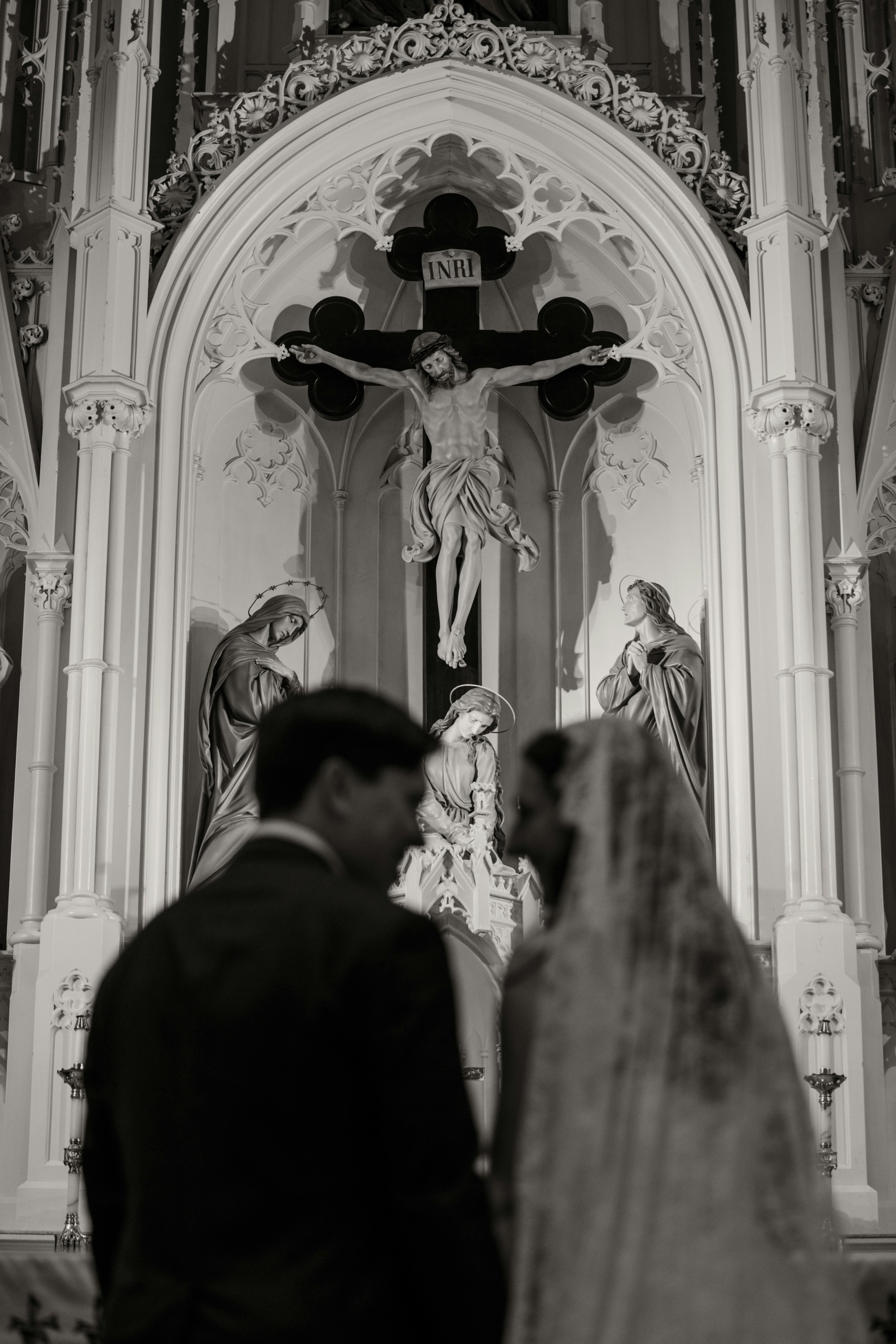
The other day I was scrolling through Facebook and came across a post in a local Sioux Falls referral group that immediately caught my attention. Someone was looking for an ordained minister for a wedding. Okay, nothing unusual there. Then I kept reading. They needed the minister for a five-minute ceremony. They already had two witnesses, a man and a woman. Then came the part that made me stop: “non-religious, just short easy and to the point!”
Wait…what?
You want an ordained minister to perform your wedding, but you specifically don’t want the wedding to be religious? What’s the point? I don’t mean that sarcastically. Well, maybe a little. But seriously, what is the point? If all you want is for the government to recognize that you and another person are now legally married, why are you seeking out someone who is ordained? Why the witnesses? Why the ceremony? Why specifically ask for a minister? At that point just put your relationship status on Facebook, link each other’s accounts, make a post saying, “We’re married!” and call it a day.
Obviously I am being facetious, but I think there is something much deeper going on here. We have become so accustomed to borrowing the fruits of Christianity while wanting absolutely nothing to do with the tree that produced them that we don’t even recognize the contradiction anymore. We want the minister, the witnesses, the vows, the ceremony, the rings and someone standing there declaring us husband and wife. Just make sure we leave God out of it.
But the ordained minister is the part I can’t get past. What exactly do we think “ordained” means? A man isn’t ordained because he took a weekend course on how to conduct weddings. Ordination literally sets someone apart for religious ministry. For Catholics, Holy Orders is a sacrament. A priest or deacon doesn’t just happen to have the legal ability to witness marriages as a side gig. His entire vocation is ordered toward the service of God and His Church. Protestants obviously understand ordination differently than Catholics do, but even there the basic premise remains: you ordain someone for ministry.
So when you specifically ask for an ordained minister, you are specifically asking for a religious minister. Then saying you don’t want religion. Do you see the problem? You can’t order the cheeseburger and then say, “Hold the burger and cheese.” What you’re left with isn’t the thing you asked for.
Why Do You Think You Need Witnesses?
This part might be even more interesting because we have become so accustomed to witnesses being part of a wedding that nobody stops to ask why they are standing there in the first place. This isn’t some cute wedding tradition we invented so the bride and groom would have somewhere to put their best friends during the ceremony. The idea of publicly witnessing covenants goes back thousands of years.
Look at the Book of Ruth. Boaz doesn’t sneak off somewhere with Ruth and announce afterward that they’re married. He goes to the city gate. The elders are there. The people are there. The transaction is public. Boaz says, “You are witnesses this day.” – Ruth 4:9. And what do the people and elders answer? “We are witnesses.” – Ruth 4:11. Why? Because something happened. Something real. Something consequential enough that the community witnessed it.
This understanding continued into Christianity. Marriage wasn’t supposed to be this secret agreement where two people disappeared into a room, said some words to each other and came out claiming to be married. In fact, clandestine marriages became enough of a problem that the Church eventually had to formally address them. At the Council of Trent, the decree Tametsi in 1563 established, where it was promulgated, a public canonical form requiring marriage before the parish priest or another authorized priest and witnesses. Why? Because marriage matters. Who consented? Was the consent freely given? Did the marriage actually happen? Was one of these people already married? Who was there? Who can testify to what occurred?
The witnesses weren’t decorations. They witnessed a covenant. And now here we are hundreds of years later saying, “I’ve got my witnesses. Now I just need an ordained minister. But absolutely no religion please.” What a strange thing we’ve done. We kept the skeleton and threw away the body.
“Why Do Christians Think They Own Everything?”
Now I can already hear the objection. “One would ask, why does the Christian think they own everything? Christians didn’t invent marriage. Christians didn’t invent witnesses. People were getting married long before Christianity existed.”
You’re right. We didn’t invent marriage. That’s precisely the point. The Christian claim isn’t that Christians invented marriage. The Christian claim is that you didn’t invent it either. Neither did the government. Neither did the Supreme Court. Neither did your state legislature. Neither did your favorite politician. Neither did the Catholic Church.
God did.
This is where I think people misunderstand the Christian argument about marriage. When Christians defend marriage, we aren’t saying, “Hey! That’s ours! Give it back!” We’re saying it was never ours to begin with. It belongs to God.
Jesus Himself makes this point when the Pharisees question Him about marriage. He doesn’t say, “Let me explain this new Christian institution I’m starting.” He takes them all the way back to creation: “Have you not read that from the beginning the Creator ‘made them male and female’?” – Matthew 19:4. Then He says, “What therefore God has joined together, let not man put asunder.” – Matthew 19:6.
Who joined them? God. That’s the claim.
And before someone says, “Well, people who aren’t Christian get married too,” yes, they do. The Catholic Church recognizes natural marriage. Marriage doesn’t suddenly become real because a Catholic priest showed up. Marriage is written into human nature before we ever get to sacramental marriage. When two baptized Christians marry, Christ raises that natural institution to the dignity of a sacrament. Grace doesn’t destroy nature. It perfects it.
So no, Christians don’t “own” marriage. Our claim is much more offensive to the modern world than that.
God does.
So What Exactly Are We Doing Here?
This brings me back to that Facebook post. You want an ordained minister. You want two witnesses. You want a ceremony. I assume you’re going to exchange some kind of consent. Someone is presumably going to declare you married. You’ll probably exchange rings. But whatever you do, make sure God doesn’t sneak into those five minutes.
Does anyone else see how bizarre that is?
If this is nothing more than a legal contract between two adults, then treat it like one. Sign the paperwork. File it with the government. Update Facebook. Congratulations. But we don’t do that, do we? Even people who want nothing to do with Christianity still feel this strange pull toward ceremony. We want someone standing there. We want people watching. We want promises spoken aloud. We want rings placed on fingers. We want somebody with some kind of authority to say, “You are now married.”
Why? Why isn’t the piece of paper enough? I think the answer is that somewhere deep down we know it isn’t enough. We know marriage means something. We know standing in front of another human being and promising your life to them is different than signing up for a cell phone plan. We know there is something profound about publicly saying, “I choose you. I give myself to you. I will remain faithful to you.”
And Christianity says: Yes! You’re right! This is profound. This is sacred. This matters. But then modern culture does something strange. It takes all of those instincts and tries desperately to explain them without God.
There Is Nothing “Short and Sweet” About a Godless Ceremony
The phrase “short, easy and to the point” might actually bother me more the longer I think about it. Not because a wedding ceremony needs to be long. Length has nothing to do with holiness. You can have a reverent wedding that isn’t some massive production. But what exactly are we rushing through?
You’re making one of the biggest promises of your entire life. You’re giving yourself to another person. For better or worse. In sickness and in health. When you’re young and beautiful and everything is easy, and when you’re old and one of you is helping the other get out of bed. When there’s money and when there isn’t. When you feel madly in love and when love requires an act of the will because the feeling isn’t there. When children come. When tragedy comes. When suffering comes. Until death.
And we want to knock this thing out in five minutes because we’ve got somewhere else to be?
There is nothing “short and sweet” about marriage. There is certainly nothing sweet about stripping God from it while borrowing the office of His minister to make it feel official. That’s the crock of it all. We want the authority without its source. We want the ceremony without the sacred. We want the covenant without the One before whom covenants are made. We want the minister without the ministry. We want witnesses without asking what exactly they’re witnessing.
And maybe that’s why this random Facebook post stuck with me. I don’t know the couple. I don’t know their story. I hope they have a wonderful marriage. I genuinely do. But I wish someone would ask them the question: Why an ordained minister?
Not just “Why do you need one legally?” Why do you want one? Because the moment you specifically request someone who has been ordained, you’re acknowledging that there is something about religious authority that belongs in that moment. You invited religion into the room when you asked for the minister.
And maybe instead of trying to figure out how to keep God out of those five minutes, it’s worth asking why generations of men and women before us thought He belonged at the center of them. Maybe the problem isn’t that Christianity keeps trying to insert God into marriage. Maybe we’ve inherited something built around Him and somehow convinced ourselves that removing Him leaves the thing unchanged.
It doesn’t.
Because the Christian understanding of marriage was never:
Man + Woman + Minister + Witnesses = Marriage.
It was always something much greater.
Man + Woman before God.
Everything else in the room is there to bear witness to that reality.


